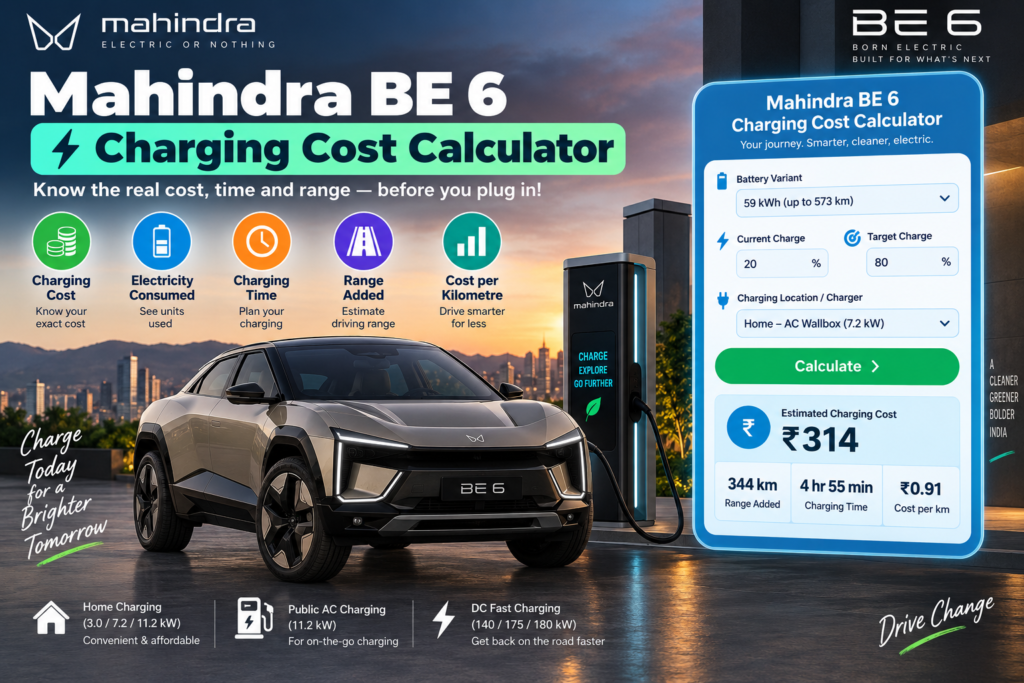
⚡ Tata Nexon EV Charging Cost Calculator
Calculate the charging cost, charging time and driving range added for your Tata Nexon.ev — at home or at a public EV charging station.
Based on Tata Motors’ published Nexon.ev specifications. Battery options shown are 30 kWh, 40.5 kWh and 45 kWh. The 45 kWh Nexon.ev has a claimed MIDC range of 489 km. Tata specifies 3.3 kW AC, 7.5 kW AC and 60 kW DC charging options for the 45 kWh model. Actual charging cost, time and range may vary depending on electricity tariff, charging network, battery temperature, battery condition, driving style and charging losses. DC charging also slows as the battery approaches a high state of charge.
⚡ Tata Nexon EV Charging Cost Calculator – Calculate Charging Cost, Time & Range
Thinking about buying a Tata Nexon.ev or already driving one? One of the biggest questions EV owners have is:
“How much does it actually cost to charge my Nexon EV?” 🔋⚡
Unlike a petrol or diesel car, an electric car doesn’t need fuel from a petrol station. You charge the battery using electricity, either at home or at a public charging station.
Our Tata Nexon EV Charging Cost Calculator helps you quickly estimate:
- 💰 Charging cost
- 🔋 Electricity consumed
- ⚡ Charging time
- 🚗 Driving range added
- 📏 Cost per kilometre
Simply select your battery variant, enter your current and target battery percentage, choose the charging method, and the calculator does the rest.
🔋 Tata Nexon EV Battery Options
The Nexon.ev is available with different battery capacities. The battery you have makes a big difference to both charging cost and driving range.
Battery
Claimed MIDC Range
30 kWh
325 km
40.5 kWh
465 km
45 kWh
489 km
The larger battery provides more range, but it also requires more electricity for a full charge.
💰 How Much Does It Cost to Charge a Tata Nexon EV?
The charging cost depends mainly on three things:
Battery energy required × Electricity rate × Charging losses
For example, suppose your Nexon EV has a 45 kWh battery and you charge it from 20% to 80%.
That’s a 60% battery increase.
Energy stored in the battery
45 × 60% = 27 kWh
If we assume around 10% charging loss, the electricity drawn from the source will be slightly higher:
27 ÷ 0.90 = 30 kWh approximately
At an electricity rate of ₹8 per unit:
30 × ₹8 = ₹240 approximately
So, charging from 20% to 80% could cost around ₹240 under these example assumptions.
Your actual amount will depend on your electricity tariff, charging losses and charging method.
🏠 Home Charging vs Public Charging
Where you charge your Nexon EV can make a big difference to the cost.
🏠 Home Charging
Home charging is generally convenient and can be cheaper than public charging, depending on your electricity tariff.
For example, if your effective electricity rate is ₹8/kWh, the calculator can use that rate to estimate your charging cost.
⚡ Public AC Charging
Public AC chargers can have a higher per-unit price than home electricity.
The calculator allows you to enter the public charging rate so you can estimate the actual cost before starting a charging session.
🚀 Public DC Fast Charging
DC fast charging is much quicker, but public DC charging is usually more expensive.
This makes DC charging useful when you are travelling and need to add range quickly.
⏱️ How Long Does It Take to Charge a Nexon EV?
Charging time depends on:
- 🔌 Charger power
- 🔋 Battery capacity
- 📊 Current battery percentage
- 🎯 Target battery percentage
- 🌡️ Battery temperature
- ⚡ Charging conditions
For example, a 7.5 kW AC charger will generally charge faster than a 3.3 kW portable charger.
The basic calculation is:
Charging time ≈ Energy required ÷ Charger power
However, real-world charging isn’t always this simple because charging power can reduce as the battery gets closer to a high state of charge.
That’s why the calculator provides an estimated charging time rather than promising an exact time.
🚗 How Much Range Do You Add by Charging?
The calculator also estimates how much driving range you gain.
For example, if a 45 kWh Nexon EV has a claimed range of 489 km, charging 20% of the battery would theoretically add approximately:
489 × 20% = 98 km
So a 20% → 80% charge represents approximately 293 km of claimed range.
Remember that this is based on the claimed test-cycle range. Real-world range can be different.
Your actual range depends on:
- 🚦 Traffic
- 🏎️ Driving style
- ❄️ Air-conditioning usage
- 🌡️ Weather
- 🛞 Tyre pressure
- 🛣️ Highway vs city driving
- 👨👩👧👦 Passenger/load
- 🔋 Battery condition
📏 What Is the Cost Per Kilometre?
One of the most useful numbers for an EV owner is cost per kilometre.
The calculator estimates:
Charging cost ÷ estimated range added
For example, if charging costs ₹240 and adds approximately 293 km of claimed range:
₹240 ÷ 293 = ₹0.82/km
That means the electricity cost is approximately 82 paise per kilometre under those assumptions.
This makes it easier to compare your Nexon EV running cost with a petrol or diesel vehicle.
🧮 How to Use the Tata Nexon EV Charging Cost Calculator
Using the calculator is simple.
Step 1: Select Your Battery Variant 🔋
Choose your Nexon.ev battery:
- 30 kWh
- 40.5 kWh
- 45 kWh
Step 2: Enter Your Current Charge
For example:
20%
Step 3: Enter Your Target Charge
For example:
80%
The calculator will calculate the energy required to move from 20% to 80%.
Step 4: Select Your Charger ⚡
You can choose from:
- 3.3 kW portable charger
- 7.5 kW AC wallbox
- Public AC charger
- 60 kW DC fast charger
- 100 kW+ DC charger
Step 5: Check the Result 💰
The calculator will show:
Estimated charging cost
along with:
- Energy added
- Electricity drawn
- Charger power
- Charging time
- Range added
- Cost per kilometre
⚙️ Customize Electricity Rate and Charging Loss
Different users pay different electricity rates.
For example, your actual home electricity cost may be different from someone living in another state or using a different tariff.
That’s why the calculator includes an “Customize Rate, Power & Efficiency” option.
You can manually change:
Electricity rate: ₹/kWh
Charger power: kW
Charging loss: %
This makes the calculator more useful for both home and public charging.
🔋 Why Does Charging Loss Matter?
The electricity taken from the grid isn’t exactly the same as the energy stored in the battery.
Some energy is lost during charging as heat and through the charging equipment.
For example, if the battery needs 27 kWh and charging efficiency is 90%:
27 ÷ 0.90 = 30 kWh
So you may need approximately 30 units of electricity from the source to put 27 kWh into the battery.
This is why simply multiplying battery capacity by your electricity rate can underestimate the real charging cost.
🆚 Tata Nexon EV vs Petrol Car Running Cost
One of the biggest advantages of an EV is potentially lower running cost.
Suppose your Nexon EV costs around ₹0.80–₹1.00 per km in electricity.
A petrol car consuming 15 km/l at ₹100/litre would cost:
₹100 ÷ 15 = ₹6.67/km
That doesn’t mean every EV will always cost less in every situation. Electricity tariffs, public charging prices and real-world efficiency vary.
However, home charging can make EV running costs significantly lower than petrol in many situations.
⚠️ Remember: Calculator Results Are Estimates
The calculator is designed to provide a practical estimate, not an exact electricity bill.
Actual results can vary because of:
- Electricity tariff
- Charging efficiency
- Battery temperature
- Battery health
- Charger performance
- Charging speed tapering
- Driving conditions
- Real-world vehicle efficiency
Public charging stations may also use different pricing models, including per-kWh charges, session fees or other applicable charges.
Always check the latest price displayed by the charging network before starting a session.
❓ Frequently Asked Questions
How much does it cost to fully charge a Tata Nexon EV?
It depends on the battery size and electricity rate. A larger battery requires more electricity, while a lower electricity rate reduces the charging cost.
Use the calculator above to enter your battery variant and electricity rate for a personalized estimate.
How much does it cost to charge Nexon EV from 20% to 80%?
It depends on the battery capacity and charging rate. For example, a 45 kWh battery needs about 27 kWh of stored energy for a 20% → 80% charge, before accounting for charging losses.
Is home charging cheaper than public charging?
Often, yes, but it depends on your home electricity tariff and the public charging station’s pricing.
What is the cost per km of Tata Nexon EV?
It depends on electricity price and real-world efficiency. The calculator estimates cost per kilometre based on the charging cost and range added.
Can I use this calculator for different electricity rates?
Yes. Open the customization section and enter your own electricity rate in ₹/kWh.
Does charging to 100% take proportionally longer?
Not necessarily. Charging can slow down at higher battery percentages, particularly during fast charging. Therefore, the final portion of a charge may take disproportionately longer.
⚡ Final Thoughts
The Tata Nexon EV Charging Cost Calculator makes it easier to understand the real cost of owning and charging an electric car.
Whether you’re charging at home overnight or using a fast charger during a road trip, you can estimate the:
🔋 Energy required → ⚡ Charging time → 💰 Charging cost → 🚗 Range added → 📏 Cost per km
Try different battery percentages, electricity rates and charger types to see how your Nexon EV charging cost changes.
For most EV owners, understanding these numbers is one of the easiest ways to plan monthly running expenses and compare EV ownership with petrol or diesel vehicles.